
Adobe Commerce Security Bulletins 2026: Every APSB Bulletin, What It Fixed and What to Apply
Shakewell ·

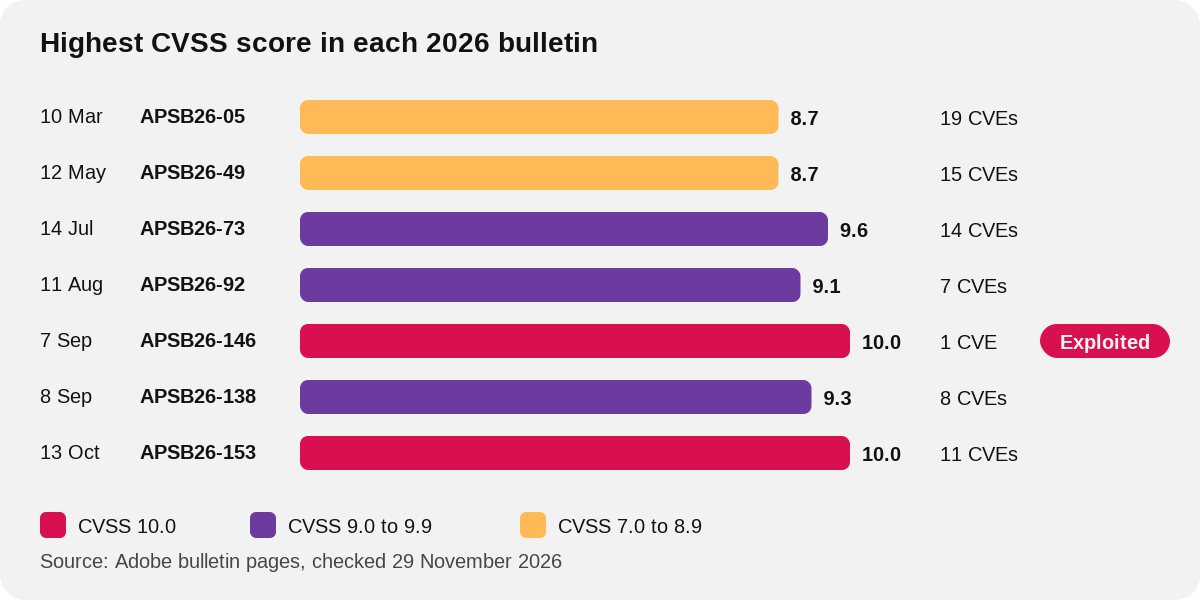
Adobe has published seven Adobe Commerce and Magento Open Source security bulletins in 2026, from APSB26-05 on 10 March to APSB26-153 on 13 October. One of them, APSB26-146, covered a vulnerability Adobe said was being exploited in the wild. We found no later bulletin on Adobe’s pages as at 29 November 2026. This page lists each one with its date, scores and what Adobe says to apply. For the commands, see our guide to applying Magento security patches, and for a running tracker with email alerts, our Magento security page.
Every 2026 Adobe Commerce security bulletin
Each row is one of the seven bulletins we found, taken from the bulletin’s own page on Adobe’s site. “Highest CVSS” is the highest base score Adobe lists in that bulletin.
| Bulletin | Date | Priority | CVEs | Highest CVSS | Exploited in the wild |
|---|---|---|---|---|---|
| APSB26-05 | 10 March | 2 | 19 | 8.7 (CVE-2026-21290) | No |
| APSB26-49 | 12 May | 2 | 15 | 8.7 (CVE-2026-34686, CVE-2026-34653) | No |
| APSB26-73 | 14 July | 2 | 14 | 9.6 (CVE-2026-48356) | No |
| APSB26-92 | 11 August | 2 | 7 | 9.1 (CVE-2026-71362) | No |
| APSB26-146 | 7 September | 1 | 1 | 10.0 (CVE-2026-75650) | Yes |
| APSB26-138 | 8 September | 2 | 8 | 9.3 (CVE-2026-76200, CVE-2026-76201) | No |
| APSB26-153 | 13 October | 2 | 11 | 10.0 (CVE-2026-103849) | No |
And what Adobe says to apply for each, for Adobe Commerce:
| Bulletin | What to apply |
|---|---|
| APSB26-05 | Security patch releases: 2.4.9-beta1, 2.4.8-p4, 2.4.7-p9, 2.4.6-p14, 2.4.5-p16, 2.4.4-p17 |
| APSB26-49 | Security patch releases: 2.4.9, 2.4.8-p5, 2.4.7-p10, 2.4.6-p15, 2.4.5-p17, 2.4.4-p18 |
| APSB26-73 | The July isolated patch files (2026-jul), one for each line from 2.4.4 to 2.4.9. Adobe Commerce Events users also update to 1.21.0 |
| APSB26-92 | The August isolated patch files (2026-aug), 2.4.4 to 2.4.9 |
| APSB26-146 | Hotfix for CVE-2026-75650 (VULN-39341). Adobe’s page lists it for Adobe Commerce and Magento Open Source, not for B2B |
| APSB26-138 | The September isolated patch files (2026-sep), 2.4.4 to 2.4.9, plus the hotfix above |
| APSB26-153 | The October isolated patch files (2026-oct), 2.4.4 to 2.4.9, or 2.4.10-alpha1, plus the hotfix above |
Magento Open Source follows the same pattern, with one change. APSB26-138 and APSB26-153 list fixed Open Source versions only for 2.4.7, 2.4.8 and 2.4.9, so Adobe publishes nothing for Open Source 2.4.6 from September on. Our end of life dates post covers why.
What the scores do and do not tell you
Three things are worth knowing before you read the table as a risk ranking.
Adobe’s “Critical” label is wider than a CVSS of 9 or above. In APSB26-138, CVE-2026-77108 is rated Critical with a CVSS score of 7.5. In APSB26-73, CVE-2026-47992 is Critical at 7.2. Adobe rates severity on its own scale, so read the CVSS score and the “authentication required” column as well as the label.
Authentication changes the picture. Every CVE in APSB26-05 and APSB26-49 requires authentication, which means an attacker needs a login first. From July, the bulletins include flaws that need none: CVE-2026-48356 in APSB26-73 (CVSS 9.6), CVE-2026-71362 in APSB26-92 (9.1), the stored cross-site scripting pair in APSB26-138 (9.3 each) and CVE-2026-103849 in APSB26-153 (10.0).
CVE counts understate the fixes. Adobe’s bulletins say that, effective 11 August 2026, it may assign a single CVE to internally discovered vulnerabilities with the same severity and weakness category when a release includes systemic fixes. A short list does not mean a small release.
Which bulletins were exploited
One. APSB26-146, published on 7 September 2026, says: “Adobe is aware of CVE-2026-75650 being exploited in the wild.” It is rated CVSS 10.0, needs no authentication, and Adobe describes the weakness as improper neutralisation of special elements in a template engine (CWE-1336). Adobe fixed it with a hotfix rather than waiting for its monthly cycle. We cover what to check beyond the patch in our write-up of that hotfix, and Adobe’s own notice adds a requirement to rotate the encryption key and the credentials it protected, because, in Adobe’s words, “rotating the encryption key alone does not invalidate credentials that may already have been exposed”.
For every other 2026 bulletin, Adobe’s statement is: “Adobe is not aware of any exploits in the wild for any of the issues addressed in these updates.”
That includes APSB26-153. Its CVE-2026-103849 also scores 10.0 and carries the same CWE-1336 weakness type as the exploited flaw, and Adobe still says it knows of no exploit. A high score with no known exploitation is a reason to patch inside the month, not a reason to ignore it, and the PCI DSS timing we cover in the patching guide applies either way.
The trap is that the hotfix is separate. Adobe’s APSB26-138 and APSB26-153 both tell you to apply the CVE-2026-75650 hotfix in addition, and the October KB article says the hotfix “is not included in the October Isolated patch file listed in this document”. A store that applies every monthly file and never the hotfix is still open.
Isolated patch, full patch and hotfix
Adobe uses three delivery types, and a bulletin tells you which one you need.
| Type | What it is | 2026 examples | Rules |
|---|---|---|---|
| Full security patch release | A new Composer version with a -pN suffix | APSB26-05, APSB26-49 | Install like any version change. Adobe says each monthly isolated patch is folded into the next one |
| Isolated security patch | A standalone patch file for one line, “non-cumulative” in Adobe’s words | APSB26-73, -92, -138, -153 | You must be on the latest -p release for your line and have applied every earlier monthly file, in order |
| Hotfix | An out-of-band fix for a critical, exploited issue | APSB26-146 | Applied separately from the monthly files. Adobe’s overview page says patch releases “can also include hotfixes” but does not define the term |
Bulletins use both forms: “-p” for a release and a label such as “2026-oct” for a patched build. The October file for 2.4.8 is named 2-4-8-p5-oct-2026.zip, and 2.4.9 has no -p release yet, so its file is 2-4-9-oct-2026.zip.
Since July, “patching” has therefore meant a monthly file on top of a -p baseline, plus a hotfix when Adobe issues one. Adobe’s policy page says monthly isolated patches ship on Patch Tuesday, the second Tuesday of the month, and “do not replace -p releases”.
Where each line stands today
Adobe’s released versions page, last updated 14 October 2026, gives these as the latest -p release for each line. October’s isolated patch (2026-oct) is the newest monthly file we found.
| Line | Latest -p release | Released | Latest monthly file |
|---|---|---|---|
| 2.4.9 | None yet (2.4.9 is the baseline) | 12 May 2026 | 2026-oct |
| 2.4.8 | 2.4.8-p5 | 12 May 2026 | 2026-oct |
| 2.4.7 | 2.4.7-p10 | 12 May 2026 | 2026-oct |
| 2.4.6 | 2.4.6-p15 | 12 May 2026 | 2026-oct |
| 2.4.5 | 2.4.5-p17 | 12 May 2026 | 2026-oct |
| 2.4.4 | 2.4.4-p18 | 12 May 2026 | 2026-oct |
One more detail for Cloud customers. Adobe’s Cloud Patches release notes list v1.1.22 on 13 October with the APSB26-153 fixes, then v1.1.23 on 19 October, which updated the October isolated patch for 2.4.8-p5 with additional defence-in-depth safeguards. If you applied that file by hand before the 19th, check that you have the updated version.
How to check what a store has applied
The version number alone is not enough. bin/magento --version shows the -p release. Each monthly patch installs Adobe’s Commerce Version Tool, and php vendor/bin/patch-status reports which monthly patches are applied, missing or unknown, and whether each CVE is marked protected or vulnerable. For the hotfix, Adobe’s check on Cloud is vendor/bin/magento-patches -n status | grep "39341\|Status", where “Applied” is the result you want. On-premises, check your deploy record for the hotfix file by name. The full set of checks is in the patching guide.
If you are behind
Our Magento patch checker lists what your version still owes. Work through it in this order. The decision tree below shows the order Adobe’s rules require for the patch files; the hotfix is independent of them, so do it first and do not wait on the rest.
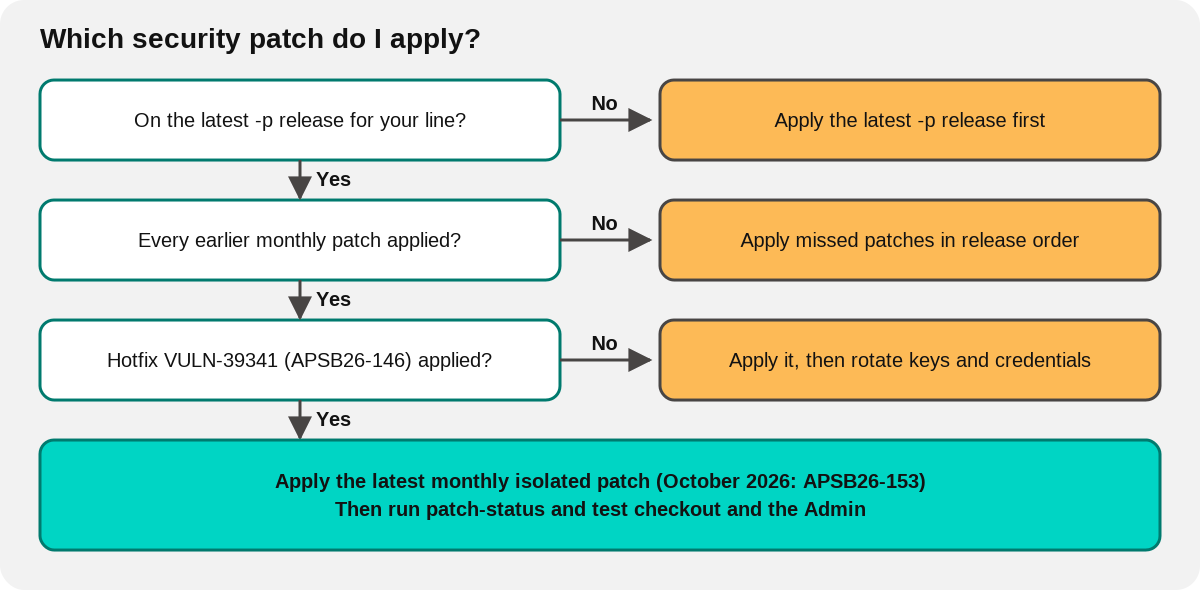
- Hotfix first if it is missing. It is the only exploited issue. Apply it, then rotate the encryption key and every credential it protected, following Adobe’s APSB26-146 notice. If your store was exposed before you patched, patching alone is not enough.
- Get to the latest -p release for your line. Adobe says isolated patches are tested only against it.
- Apply each missed monthly patch in order. Adobe’s example: if you missed July and August, apply July, then August, then September. Isolated files do not bundle the ones before them.
- Test and confirm. Place a test order, log in to the Admin, check cron, then run
patch-status.
If your line has no patch to apply, that is a different problem. On 2.4.4, 2.4.5 and 2.4.6, Adobe’s isolated fixes come from extended or security-only periods and are available to Adobe Commerce customers only, and the dates are in our end of life post. A store that is several versions behind usually needs an upgrade rather than a pile of patch files.
What comes next
Adobe’s 2026 calendar lists 10 November and 8 December as optional releases for 2.4.4 to 2.4.9, “due to holiday code freeze”. We found no November bulletin on Adobe’s pages. Adobe has not published a 2027 calendar, so the dates for next year’s bulletins are not set. We lay out what Adobe has and has not published in our release schedule post.
If you would rather hand this to someone, Magento support covers reading each bulletin, applying it on staging first and taking it live with a way back. Two of our developers hold Adobe Commerce certifications, and the Adobe Commerce page has more on how we work.
Sources, checked 29 November 2026: APSB26-05, APSB26-49, APSB26-73, APSB26-92, APSB26-146, APSB26-138 and APSB26-153 (Adobe security bulletins), Urgent action required: APSB26-146, APSB26-153 release notes, Security patch release notes, Monthly isolated security patching policy, Cloud Patches for Commerce, Released versions and Release schedule.
Common questions
What is the latest Adobe Commerce security bulletin?
APSB26-153, published on 13 October 2026. It is a priority 2 update covering 11 CVEs, with a highest CVSS score of 10.0 (CVE-2026-103849), and Adobe says it is not aware of any exploits in the wild for them. We found no later Adobe Commerce bulletin on Adobe's pages as at 29 November 2026, although Adobe's calendar lists 10 November and 8 December as optional release dates.
Which 2026 Magento security bulletin was exploited in the wild?
Only APSB26-146, published on 7 September 2026. Adobe says it is aware of CVE-2026-75650, scored CVSS 10.0, being exploited in the wild, and fixed it with a hotfix. For every other 2026 Adobe Commerce bulletin, Adobe says it is not aware of any exploits in the wild.
Does the October 2026 patch include the CVE-2026-75650 hotfix?
No. Adobe's APSB26-153 release notes say the hotfix for CVE-2026-75650 is not included in the October isolated patch file and must be applied separately. Both the APSB26-138 and APSB26-153 bulletins tell you to apply it in addition to the monthly update. A store on a 2026-oct build is not covered unless the hotfix was applied as well.
How many Adobe Commerce security bulletins has Adobe published in 2026?
Seven that we found: APSB26-05 (10 March), APSB26-49 (12 May), APSB26-73 (14 July), APSB26-92 (11 August), APSB26-146 (7 September), APSB26-138 (8 September) and APSB26-153 (13 October). Adobe's release calendar shows no scheduled release in January, February, April or June.
What is the difference between a security patch release and an isolated patch?
A security patch release is a new Composer version with a -pN suffix, such as 2.4.8-p5. An isolated patch is a standalone patch file, not cumulative, built for the latest -p release of a line. Adobe folds each monthly isolated patch into the next full security patch release, and you must apply the monthly files in release order.