
Services
PIM
We implement and integrate the leading product information management platforms so your catalogue is accurate, enriched and flowing automatically to every channel you sell on.
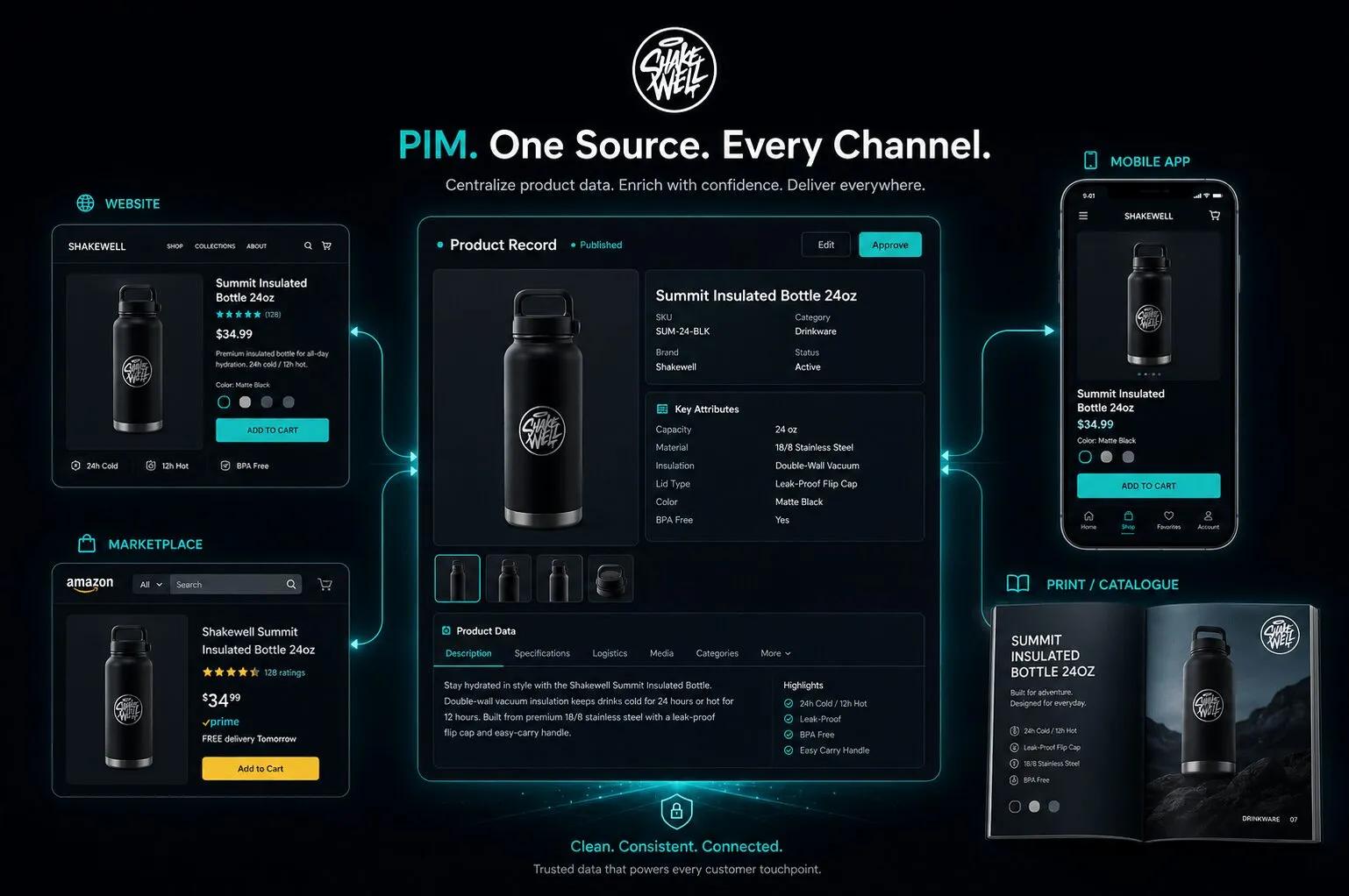
Why PIM
Retail catalogues have outgrown spreadsheets. Thousands of SKUs, each with images, specifications, compliance data, rich descriptions and channel-specific requirements, cannot be managed by hand without errors leaking onto your storefront. A PIM gives every product a single source of truth and every channel a clean, automatic feed. Better data means better search, better conversion and fewer returns.
The platforms we work with
Akeneo
The leading open-source PIM. We implement Akeneo Community and Enterprise, model your product taxonomy, and connect it to Adobe Commerce and Shopify. Strong fit for retailers who want control and extensibility.
Salsify
Enterprise PXM for brands syndicating product content to major retailers and marketplaces. We integrate Salsify with your commerce stack and automate the flow of enriched content to every endpoint.
SKUvantage
The Australian syndication platform used across local grocery and retail. We connect SKUvantage feeds into your PIM and commerce platform so locally syndicated content lands in your catalogue automatically.

What we do
PIM selection
honest advice on which platform fits your catalogue, team and budget
Implementation
taxonomy design, attribute modelling, data migration and go-live
Integration
two-way sync with Adobe Commerce, Shopify and ERPs
Data enrichment workflows
approval flows, completeness scoring and channel readiness rules
Ongoing support
keep the pipes flowing as your catalogue and channels grow
Not sure which PIM is right for you?
We will tell you straight, including whether you need one at all.
Our approach
We implement and integrate product information management platforms so your catalogue lives in one accurate source of truth and flows automatically to every channel you sell on. The advice is straight: we will tell you which platform fits your catalogue, team and budget, including whether you need a PIM at all, which for a single-channel retailer is often the honest answer.
When a PIM starts paying for itself
The trigger is almost never SKU count, which is the number people reach for first. It is the number of places the same product has to be correct.
A retailer with 40,000 SKUs on one storefront usually does not need a PIM. A retailer with 2,000 SKUs selling through a storefront, a marketplace, a wholesale portal and a printed catalogue almost certainly does, because somewhere in that business a person is maintaining four versions of the same description, and the versions have already drifted.
Four signals that the threshold has been crossed:
- The same product is authored in more than one system, and nobody can say which one is right.
- Launching a new channel is a data project, not a commercial decision.
- Filters and faceted search work badly because attributes are inconsistent across products that should share them.
- Returns include “not as described” with any regularity.
What we solve
- Product data managed by hand in spreadsheets, with errors leaking onto the storefront
- Thousands of SKUs whose images, specifications and compliance data no one can keep current
- Every sales channel demanding its own format, fed by copy-paste
- Product content and pricing falling out of sync across stores and locations
- Channel launches that stall because the catalogue is not ready
What a PIM implementation actually involves
Four phases, and the first one decides the cost of the other three.
1. Taxonomy and attribute modelling. Deciding what a product is in your business: which attributes are mandatory, which vary by category, and what “complete” means for each channel. This is the phase clients expect to be quick and it is the phase that determines whether the system is usable in two years. It is also mostly a business exercise rather than a technical one.
2. Migration and cleansing. Getting data out of spreadsheets and the commerce platform and into a structure. The work here is proportional to how bad the data is, which is usually worse than anyone believes. We would rather audit it and tell you than quote around an assumption.
3. Integration. The PIM feeds the storefront and receives from the ERP. The engineering is rarely the hard part. Agreeing which system wins when two disagree is, and that is a decision someone in the business has to make.
4. Enrichment workflows. Approval flows, completeness scoring and channel readiness rules, so the catalogue stays accurate after go-live rather than decaying back toward the spreadsheet it replaced.
Choosing a platform
There is no best PIM, only a best fit, and the deciding question is who will operate it day to day.
- Akeneo, the leading open-source PIM. Strong for retailers who want control and extensibility and have someone technical to own it. We implement Community Edition and Akeneo’s SaaS packages, model the taxonomy, and connect it to Adobe Commerce and Shopify (how a PIM syncs to Shopify). Akeneo 7 reached end of support on 30 September 2026, so if you still run it on-premise or on PaaS, it is time to choose a route. Weighing Akeneo against Pimcore? See Pimcore vs Akeneo.
- Salsify, enterprise PXM for brands syndicating product content out to major retailers and marketplaces. The right answer when your problem is distribution rather than internal management.
- SKUvantage, the Australian syndication platform used across local grocery and retail. We connect its feeds into your PIM and commerce platform so locally syndicated content lands automatically.
- A lighter SaaS PIM, often correct for a smaller catalogue where the real problem is that product data lives in spreadsheets. Paying for an enterprise platform to solve a spreadsheet problem is a common and expensive mistake.
What’s included
- PIM selection advice matched to your catalogue, team and budget
- Taxonomy design, attribute modelling, data migration and go-live
- Two-way integration with Adobe Commerce, Shopify and your ERP
- Enrichment workflows, approval flows and completeness scoring
- Ongoing support as the catalogue and channel mix grow
What bad product data actually costs
It surfaces in three places, and only one of them is obvious.
Search and filtering degrade when attributes are missing or inconsistent, because faceted navigation can only be as good as the data behind it. Conversion falls when a shopper cannot find the detail they need to decide. And returns rise, because a wrong specification gets discovered after delivery instead of before it.
The third is the expensive one, and it is almost never attributed back to the catalogue: it gets recorded as a logistics cost or a customer service problem.
Related work
Product data sits underneath most of the commerce problems we are asked to fix. If a replatform is on the table, it is worth reading what we look for before an e-commerce migration: a new storefront inherits a messy catalogue intact, and cleaning it first is cheaper than cleaning it twice. For the integration side, what ERP integration really costs covers the four questions that set the price.
- 2018
- building since
- 70+
- designers, engineers and product people
- Sydney
- headquarters with team members across several countries
- 230+
- code repositories in our own GitHub organisation, before counting client-owned ones
Common questions
What does a PIM implementation actually involve?
Four phases, and the first is the one that decides the cost. Taxonomy and attribute modelling comes first, deciding what a product is in your business, which attributes are mandatory, and what "complete" means per channel. Then data migration and cleansing from wherever it lives now, usually spreadsheets and the commerce platform. Then integration, so the PIM feeds the storefront and receives from the ERP. Then enrichment workflows and approvals so it stays accurate after go-live. Most projects run in months rather than weeks, and most of the risk sits in phase one.
Which PIM platform should we choose?
It depends on catalogue complexity and who will operate it, not on feature lists. Akeneo suits retailers who want control and extensibility and have someone technical to own it. Salsify suits brands syndicating content out to major retailers and marketplaces. A lighter SaaS PIM is often right for a smaller catalogue where the real problem is spreadsheets rather than syndication. We will tell you which fits, including when the honest answer is that you do not need a PIM yet.
Do we need a PIM, or will our e-commerce platform do?
Your commerce platform stores product data for one channel. A PIM manages it for all of them, which only matters when you have more than one. The threshold is usually not SKU count. It is channels, languages, or the moment someone is maintaining the same product in two places. If you sell on one storefront and nothing else, the platform is probably enough and a PIM is cost without return.
Is a PIM worth it for a small business?
Sometimes, and the deciding factor is channels rather than size. A small retailer selling on a storefront, a marketplace and through wholesale is maintaining three versions of the truth, and that is expensive in staff time and errors long before the catalogue gets large. A larger retailer on a single channel often is not. Count the places a product description has to be correct, not the number of SKUs.
Can a PIM integrate with our existing store and ERP?
Yes, and that integration is where most of the engineering effort goes. The pattern that works is clear ownership: the ERP owns commercial data, the PIM owns product content, the storefront owns presentation, and nothing is authored in two places. The hard part is rarely the connector. It is agreeing which system wins when two disagree, which is a business decision before it is a technical one.
Who can fix messy product data in Australia?
We do, and the first step is usually not a PIM. We audit the catalogue where it lives now, spreadsheets, the commerce platform, the ERP, and tell you how bad it is and what fixing it involves: attribute modelling, cleansing and de-duplication, then a single source of truth with completeness rules so it stays fixed. For a smaller catalogue the honest answer is often a lighter SaaS PIM rather than an enterprise one. We are a Sydney team working with retailers, brands and suppliers across Australia and New Zealand.
Do you help manufacturers and brands get product data to retailers?
Yes. When the problem is distribution rather than internal management, the work is syndication: one enriched record feeding every retailer and marketplace in the format each one demands. Salsify is built for that at enterprise scale, and SKUvantage is the Australian platform used across local grocery and retail. We connect those feeds to your PIM, ERP and own storefront so a change is made once, not once per retailer.
What does bad product data actually cost?
It shows up in three places. Search and category pages perform worse because attributes are missing or inconsistent, so filters do not work. Conversion drops because shoppers cannot find what they need to decide. And returns rise, because a wrong specification is discovered after delivery rather than before. The last one is the expensive one, and it is the one nobody attributes back to the catalogue.
Engagement models
How we work
Four straightforward ways to engage us. Pick the one that fits, or mix them as your needs change.
Staff Augmentation
Add experienced Shakewell developers, designers or specialists directly to your own team. Engagements typically run three to twelve months, but can be as short or long as you need, you get the skills without the commitment and cost of hiring full-time.
About staff augmentationFixed-Scope Projects
Have a defined outcome in mind? We scope it, price it and deliver it as a project, a clear timeline, agreed milestones and a single point of accountability from kickoff to handover.
Embedded Delivery Teams
For larger or longer-running work, a cross-functional Shakewell team (development, design and delivery management) plugs in as your delivery arm, working to your priorities and your reporting cadence.
Support & Maintenance
Already live? We keep websites, stores and apps secure, updated and performing through ongoing retainers, business-hours support as standard, with 24/7 coverage available for critical issues.
About support & maintenanceTrusted by























“We partnered with Shakewell in 2024 to help improve and maintain our website technology. The team are friendly, diligent and routinely demonstrate a breadth of technical understanding that is hard to find. Their support has put us in a much stronger position to scale and enhance our web presence.”
Aidan Arentz
Digital Product Owner of Merivale
“Hannah and the team have been instrumental in building a strong inbound lead model, nurturing potential clients with timely email communications, and supporting our sales team. This helped us secure over 300 new members, all before opening our doors!
Each social media post has been impactful, and the ads capture the brand’s tone perfectly. I highly recommend Shakewell for high-performance digital marketing focused on brand positioning and strategic growth.”
Briony Fischer
Club Manager, B3 by Social Remedy
Start a conversation
Start a conversation
Tell us what you want to build, fix or scale, we’ll come back with a clear way forward.