
Services
UX / UI Design
As a ux/ui design agency we focus on creating user-friendly and visually appealing interfaces for software applications, websites, and digital products. Ux (user experience) and ui (user interface) design are essential components of software development, as they directly impact how users interact with and perceive the software.
Our objective is an intuitive and enjoyable user experience, which is achieved through meticulous interface design and rigorous user testing. This includes harmonising your website’s design elements with your brand’s visual identity, encompassing aspects such as logo design and colour schemes.
Our DESIGN service includes
User Experience (UX) Design
- User Research: Conducting user research to understand the target audience, their needs, and behaviors.
- Information Architecture: Organizing and structuring content and features in a logical and intuitive manner.
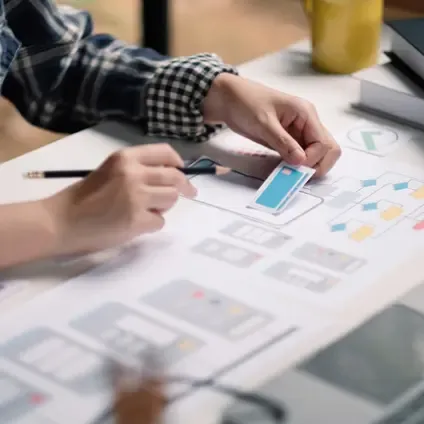
- Wireframing: Creating low-fidelity wireframes to outline the layout and flow of the application, focusing on functionality and user interaction.
- Prototyping: Developing interactive prototypes to test and refine the user experience before development begins.
- Usability Testing: Conducting usability tests to gather user feedback and make necessary adjustments.
- User Journey Mapping: Defining user personas and mapping out user journeys to ensure a seamless and engaging experience.
- Accessibility: Highly detailed and polished representations of a digital product or user interface.
User Interface (UI) Design
- Visual Design: Crafting the visual elements of the software, including colour schemes, typography, iconography, and imagery.
- Layout Design: Creating the layout and structure of the application, emphasizing aesthetics and user-friendly design.
- Responsive Design: Adapting the UI to various screen sizes and devices to ensure a consistent and user-friendly experience.
- Design System: Developing a design system or style guide to maintain visual consistency across the software and future updates.
- Interactive Design: Designing interactive elements like buttons, forms, animations, and micro interactions to enhance user engagement.
- Brand Consistency: Ensuring that the software’s UI aligns with the client’s branding and messaging.
Our Design Process
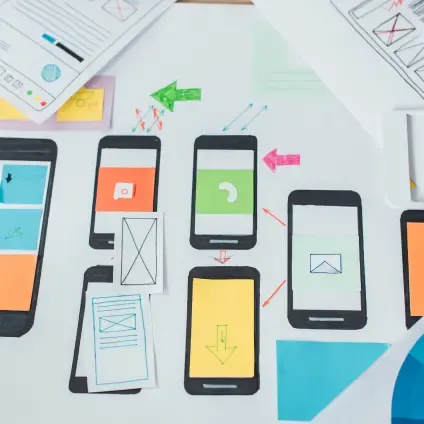
We follow an Iterative Design Process, which means continuously refining and improving the design based on feedback, usability testing, and changing requirements. We always adapt to emerging design trends and technologies to keep the software up to date.
Collaborating closely with the client to understand their vision, goals, and preferences is essential. Providing regular updates and incorporating client feedback throughout the design process.
Conducting quality checks to ensure the final design is error-free, aligns with best practices, and meets client expectations.
A well-executed UX/UI design can greatly enhance the overall user experience and increase user engagement with the software, ultimately leading to higher user satisfaction and business success.
Our approach
We design digital products people can actually use, websites, apps, portals and the interfaces inside them. That covers the whole customer experience rather than the visual layer alone: what someone is trying to do, the steps between them and doing it, and the design decisions that remove friction from those steps.
Most projects that arrive described as a design problem turn out to be a structure problem. A beautiful interface over a confusing model is still confusing, which is why we start with the journey and the content before the surface.
Customer experience design
Customer experience is the whole path someone takes with you, and the digital product is usually the part where it succeeds or fails. The work that shapes it:
Research with actual users. For MUK Haircare, competitor research and customer interviews surfaced the real pain point, a lack of clear usage directions, which is what drove a content-forward experience with how-to videos through the product journey rather than a straight catalogue.
Journey mapping. Following a person end to end, including the steps that happen outside your product. For GPSL that meant remapping the user journey to make high-priority content findable, because the problem was navigation rather than aesthetics.
Workshops with the people who know. Sitting with the internal teams who handle the requests, the complaints and the exceptions. They know where the process actually breaks.
Prototypes before code. Wireframes and high-fidelity designs that let people react to something concrete while it is still cheap to change. For the SES content portal, discovery produced wireframes for core journeys and mid-fidelity designs before anything was built.
UI design and design systems
A design system is what stops a product drifting as it grows, and it is the deliverable that keeps paying after we leave.
For Skin Check Champions our scope was UX and UI specifically, after the charity restructured delivery around its own engineering and product teams: workshops, mapped user flows, high-fidelity mobile-first designs, a component library and design-system documentation, handed over in Figma for their team to build against, specified to WCAG 2.1 AA from the start.
For Safeproud, a strong design system steps administrators through form creation without overwhelming them, a problem we saw across every other form builder we reviewed.
Accessibility is part of design
Colour contrast, focus states, target sizes, heading structure and keyboard paths are design decisions, not a pre-launch audit. Building them in costs a fraction of retrofitting them, and for anyone selling into government, education or financial services it is a procurement gate rather than a preference. See accessibility and WCAG compliance.
What we solve
- Products that look finished but confuse the people using them
- Interfaces that grew feature by feature until nothing is where anyone expects
- Design that falls apart the moment a new page or state is added
- Teams shipping inconsistent work because there is no system to build against
- Accessibility discovered late, when it is expensive
What’s included
Discovery and stakeholder workshops, user research where the risk justifies it, journey mapping and information architecture, wireframes and high-fidelity design, component libraries and design-system documentation, prototypes, and handover in Figma your team can build from.
We are based in Sydney and work with organisations across Australia. Where a project needs build as well as design, the same team carries it through, see website development and app development.
- 2018
- building since
- 70+
- designers, engineers and product people
- Sydney
- headquarters with team members across several countries
- 230+
- code repositories in our own GitHub organisation, before counting client-owned ones
Common questions
What is the difference between UX and UI design?
UX is how it works: structure, flows, what happens at each step and why. UI is how it looks and feels: layout, typography, colour, interaction. A product can be beautiful and unusable, or plain and effective. Most projects that feel like a design problem are actually a structure problem, which is why we start there.
Do you do accessibility as part of design?
Yes, and it is much cheaper as a design decision than a remediation project. Colour contrast, focus states, target sizes, heading structure and keyboard paths are all decided at design time. Retrofitting WCAG compliance onto a finished build costs several times what designing for it would have.
Can you redesign without rebuilding everything?
Often, yes. A design system applied to an existing codebase can transform how a product feels without touching what sits underneath. We look at what the current build can carry before assuming a rebuild, a redesign and a replatform are separate decisions and should be made separately.
What is the difference between UX, UI and customer experience?
UI is what it looks like. UX is how the product works, structure, flows, what happens at each step. Customer experience is wider than the product: every touchpoint someone has with you, including the ones that are not digital. In practice the digital product is where CX succeeds or fails, so the useful work is designing the journey rather than treating the interface as a separate exercise.
Do you do customer experience design, or just interfaces?
Both, and the first usually determines whether the second matters. We run stakeholder workshops, map journeys end to end including the steps that happen outside your product, and research with real users where the risk justifies it, for MUK Haircare, competitor research and customer interviews are what identified the actual problem. Then we design the interface that resolves it.
What do we get at the end?
Wireframes and high-fidelity designs, a component library and design-system documentation, and prototypes where they help, handed over in Figma so your team can build from them. The design system is the part that keeps paying: it is what stops the product drifting as new pages and states get added after we leave.
Do you work with clients outside Sydney?
Yes. Our office is in Sydney and we work with organisations across Australia. Design work runs well remotely, workshops over video, designs reviewed in Figma, and a shared board you can see at any time. We are happy to run workshops in person in Sydney where that suits.
Do you test designs with real users?
Where the risk justifies it. For a marketing site, structured review with the people who know the audience is usually proportionate. For a portal or product that thousands of people will use daily, testing with actual users before build is the cheapest insurance available.
Do you work with clients outside Sydney?
Our head office is in Sydney and we work with clients across Australia (Melbourne, Brisbane, Perth, Adelaide and regional NSW included) as well as in New Zealand, where the duty free stores across the major airports have run on a platform we build and support since 2021. Delivery has been remote-first for years, so a project runs the same way whether you are ten minutes away or across the Tasman: scheduled calls, a shared board you can see at any time, and one named point of contact. We are happy to meet in person in Sydney.
Engagement models
How we work
Four straightforward ways to engage us. Pick the one that fits, or mix them as your needs change.
Staff Augmentation
Add experienced Shakewell developers, designers or specialists directly to your own team. Engagements typically run three to twelve months, but can be as short or long as you need, you get the skills without the commitment and cost of hiring full-time.
About staff augmentationFixed-Scope Projects
Have a defined outcome in mind? We scope it, price it and deliver it as a project, a clear timeline, agreed milestones and a single point of accountability from kickoff to handover.
Embedded Delivery Teams
For larger or longer-running work, a cross-functional Shakewell team (development, design and delivery management) plugs in as your delivery arm, working to your priorities and your reporting cadence.
Support & Maintenance
Already live? We keep websites, stores and apps secure, updated and performing through ongoing retainers, business-hours support as standard, with 24/7 coverage available for critical issues.
About support & maintenanceTrusted by


















“We partnered with Shakewell in 2024 to help improve and maintain our website technology. The team are friendly, diligent and routinely demonstrate a breadth of technical understanding that is hard to find. Their support has put us in a much stronger position to scale and enhance our web presence.”
Aidan Arentz
Digital Product Owner of Merivale
“Hannah and the team have been instrumental in building a strong inbound lead model, nurturing potential clients with timely email communications, and supporting our sales team. This helped us secure over 300 new members, all before opening our doors!
Each social media post has been impactful, and the ads capture the brand’s tone perfectly. I highly recommend Shakewell for high-performance digital marketing focused on brand positioning and strategic growth.”
Briony Fischer
Club Manager, B3 by Social Remedy
Start a conversation
Start a conversation
Tell us what you want to build, fix or scale, we’ll come back with a clear way forward.