
Next.js Versions: Latest Version, Release Dates and Support Policy
Shakewell ·

The latest stable version of Next.js is 16.4.6, published on 9 November 2026. This post puts the version history, the official support policy and the minimum Node.js and React versions in one place, and explains how to find the version a project runs and how often to move. Every fact was checked on nextjs.org, GitHub and npm on 29 November 2026.
The latest Next.js version
Three sources agree on the current stable release:
- GitHub. The Next.js releases page marks v16.4.6 as the latest release, published on 9 November.
- npm. The
latestdist-tag on thenextpackage points to 16.4.6. - nextjs.org. The newest minor release post is Next.js 16.4, dated 6 October 2026. Patch releases such as 16.4.6 are not announced with their own posts.
A 16.5 release candidate (16.5.0-rc.0, published 28 November 2026) is also on npm under the rc tag. Vercel has not published a post for it, so we treat it as pre-release. If you run npm install next@latest today, you get 16.4.6.
The minor releases of Next.js 16 so far:
| Version | Released |
|---|---|
| 16.0 | 21 October 2025 |
| 16.1 | 18 December 2025 |
| 16.2 | 18 March 2026 |
| 16.3 | 3 August 2026 |
| 16.4 | 6 October 2026 |
Release history from 13 to 16
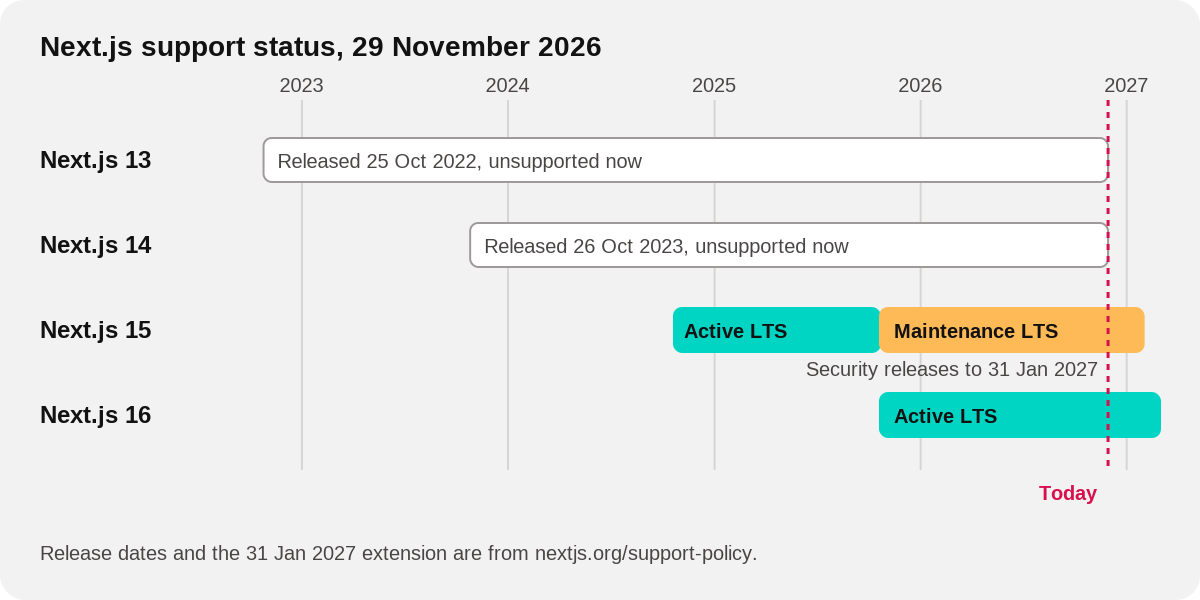
Since 2022, Next.js has shipped one major version a year, in late October, and several minor versions between them.
| Major version | Released | Support status on 29 November 2026 |
|---|---|---|
| 16 | 21 October 2025 | Active LTS |
| 15 | 21 October 2024 | Maintenance LTS, security releases through 31 January 2027 |
| 14 | 26 October 2023 | Unsupported |
| 13 | 25 October 2022 | Unsupported |
The dates above come from each version’s release post on nextjs.org. The support policy page lists 13 as 26 October 2022 a day later. Next.js 12 and everything older is also listed as unsupported.
The official support policy
Vercel’s support policy page sets out a long-term support model with two phases:
- Active LTS. “A major version of Next.js remains in Active LTS until the subsequent major version is released.” It gets new features, regular bug fixes, performance improvements and security patches.
- Maintenance LTS. When a new major is released, the previous one moves here. Vercel “commits to shipping only critical bug fixes and essential security updates.” Each major stays in Maintenance LTS for two years after its initial release.
Three details matter in practice:
- Next.js 15 got an extension. The policy says Maintenance LTS for 15 “has been extended beyond its original end date of Oct. 21, 2026”, with security releases continuing through 31 January 2027. Treat that as a deadline for a move to 16, not a reason to wait.
- Maintenance releases can be breaking. The policy says that for Maintenance LTS versions, updates “will land as semver-minor releases, even if they are breaking changes.” Do not assume a minor bump on an old major is a safe drop-in.
- Outside the policy is rare. Vercel says that in rare circumstances it will patch versions outside the policy, depending on the severity of the bug. It is not something to plan around.
The policy also says to serve production applications with the latest Active or Maintenance LTS release, and not to serve production traffic from canary builds.
Minimum Node.js and React versions
The Node.js minimum comes from the engines field in each version’s package.json on npm, and from the upgrade guides on nextjs.org. The React column describes what the upgrade guides say about the version you install alongside it.
| Next.js | Minimum Node.js | React |
|---|---|---|
| 16 | 20.9 (TypeScript 5.1 or later) | App Router uses React 19.2 or later features (16.4 ships React 19.3); the package peer range still lists 18.2 or 19 |
| 15 | 18.18 | React 19 is the minimum in the upgrade guide; the peer range still lists 18.2 |
| 14 | 18.17 | React 18.2 |
| 13 | 16.14 (13.5.x; 13.0 listed 14.6) | React 18.2 (13.0 listed 18.0) |
Two warnings. First, Node.js 18 and 20 are both past end of life, so the framework’s minimum is not a safe choice: our Node.js end of life dates post lists the versions that still receive fixes. Second, the React versions in the peer range are what the package manager accepts. For the App Router, follow the upgrade guide and use React 19 or later.
Is there a Next.js 17?
Not as a release, and no date has been published. We checked three places:
- The Next.js blog has no Next.js 17 post. The newest posts are the 17 November 2026 post on AI and security and the November security release.
- The npm registry has no 17.x versions. The
canarytag is a 16.5.0 canary. - The one mention is in the Next.js 16.4 post. It says Cache Components, “will become the default in Next.js 17”, and recommends Cache Components for every new app from 16.4. All new apps created with
create-next-appnow have it enabled.
Anything more specific about timing or contents is a guess. Vercel’s pattern has been one major each October, but nothing published commits to that for 17. When 17 does ship, 16 moves to Maintenance LTS under the policy.
How to find the version a project runs
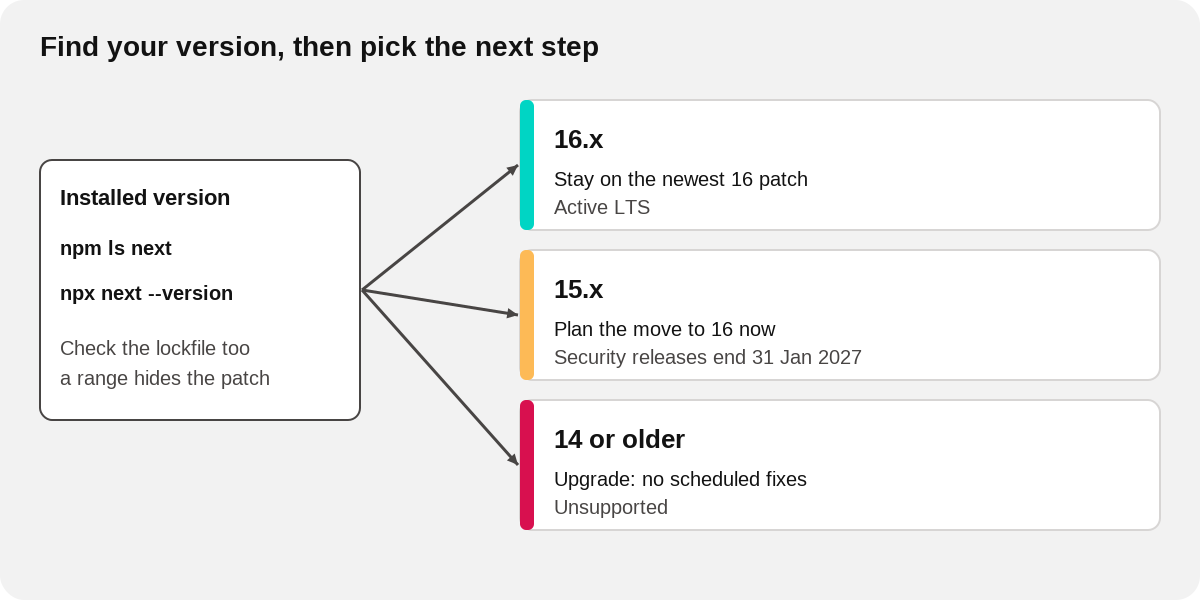
Check what is installed, not what package.json allows. A range such as ^16.2.0 hides the patch version.
npm ls next
npx next --version
npx next info
next --version (or -v) prints the version number. next info prints details for bug reports, including the versions of next, react and react-dom and the Node.js binary. Then check:
- The lockfile.
package-lock.json,yarn.lockorpnpm-lock.yamlholds the version a clean install will give you. - The build environment. CI and Docker images often run a different Node.js version from your laptop.
- Every app in a monorepo. Each workspace can pin its own
next.
How often to upgrade
There is no single right cadence, but the published signals suggest a pattern:
| What | Our suggestion | Why |
|---|---|---|
| Patch releases | Take security releases promptly | Vercel now publishes scheduled security releases, and the blog shows them in July, August, September and November 2026, plus out-of-band updates on 22 September and 14 October |
| Minor releases | Move within a few weeks, after staging tests | You stay on Active LTS patches and avoid a larger jump later |
| Major releases | Plan within the first year | While the previous major is still in Maintenance LTS |
Next.js 16.4 also adds an experimental.agentUpgrade option. When you run next dev or next build, it reminds you or your coding agent when an upgrade is available. Its default policy, security, only reminds you about upgrades that address known vulnerabilities in your installed version.
Skipping a major is possible but adds risk, because each major removes things the previous one deprecated. Our Next.js 16 upgrade guide covers the codemod, what breaks from 14 or 15, testing and rollback.
When we get involved
If you are unsure what is deployed, or the Node.js version is older than the framework needs, that is a good reason to ask. We run Next.js development and framework and runtime upgrades as planned projects, and we treat the framework and Node.js as one piece of work, since their end dates often fall in different months.
Sources: Next.js support policy, Next.js blog, Next.js 16.4, Next.js 16 upgrade guide, Next.js 15 upgrade guide, Next.js 14 upgrade guide, next CLI reference, Next.js v16.4.6 release on GitHub and the next package on npm, checked 29 November 2026.
Common questions
What is the latest version of Next.js?
16.4.6, published on 9 November 2026. It is marked as the latest release on GitHub and is the latest tag on npm. Next.js 16.4 itself came out on 6 October 2026. A 16.5 release candidate is on npm, but it is not the stable release.
Is Next.js 15 still supported?
Yes, in Maintenance LTS. Vercel's support policy says it will keep publishing security releases for Next.js 15 through 31 January 2027, which extends the original end date of 21 October 2026. Only critical bug fixes and essential security updates are shipped to it.
Is there a Next.js 17?
Not as a release. As at 29 November 2026 the Next.js blog has no Next.js 17 announcement and npm has no 17.x versions. The Next.js 16.4 post says Cache Components, the programming model it recommends for every new app, will become the default in Next.js 17. It gives no date.
What Node.js version does Next.js 16 need?
Node.js 20.9 or later, with TypeScript 5.1 or later. Node.js 20 itself reached end of life on 30 April 2026, so we would run Node.js 22, 24 or 26 in production. Next.js 15 supports Node.js 18.18 and later.
How long does a Next.js version get support?
A major version is in Active LTS until the next major is released, then moves to Maintenance LTS. Vercel's policy says each major stays in Maintenance LTS for two years after its initial release. After that it is unsupported, though Vercel may patch severe bugs outside the policy.